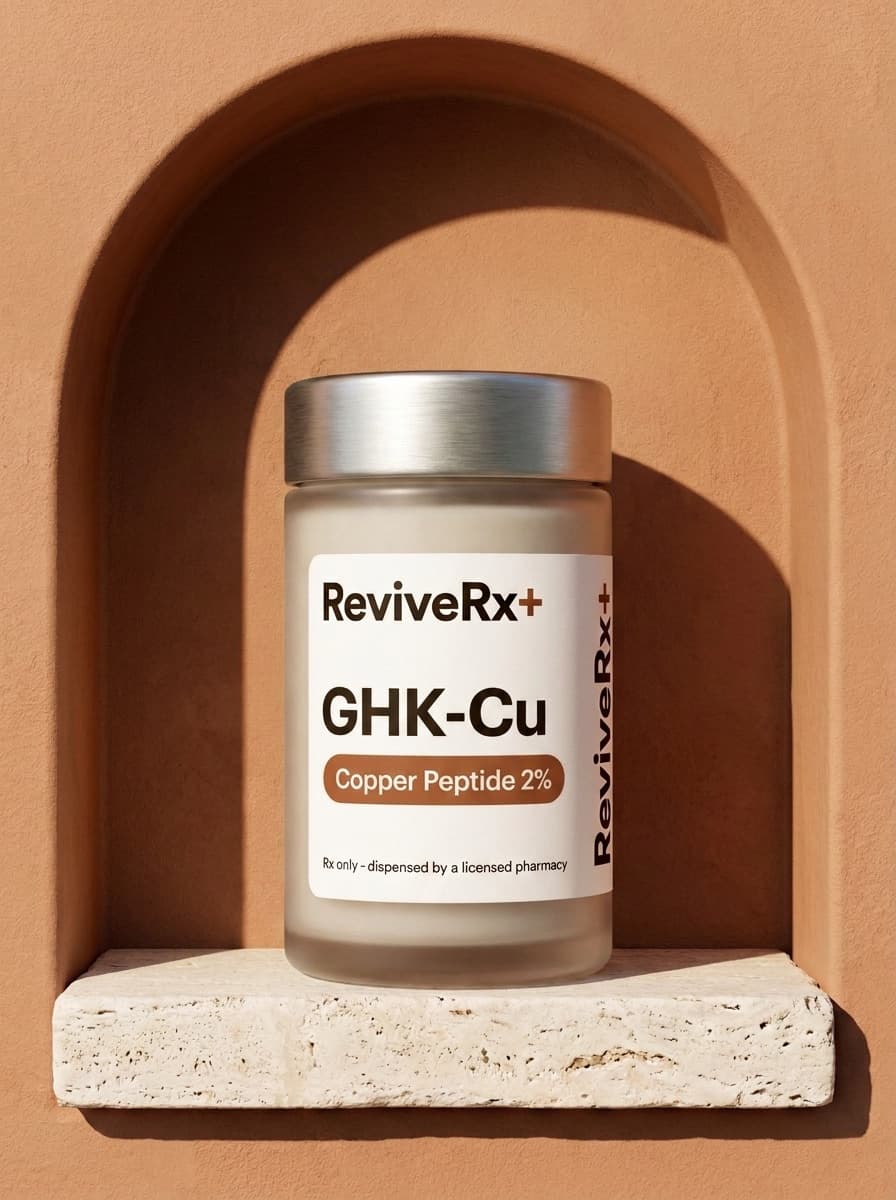
Compounded GHK-Cu
Compounded — topical cream
A copper-binding peptide in a topical cream, studied mostly in the laboratory — not a retinoid substitute.
$219 4-week supply $32 consultation included, not refunded · medication and shipping if prescribed
Choose your option
4-week supply
Price
$219 for a 4-week supply, if prescribed
Includes your $32 provider consultation (non-refundable). If your provider decides treatment isn’t appropriate, the medication portion is refunded automatically.
- Not available in California or South Carolina.
Paying books a visit with a licensed provider, who decides whether to prescribe and which strength is appropriate. If nothing is prescribed, the medication portion is refunded automatically; a higher strength costs more only if you approve that charge.
How it works
GHK-Cu is not an FDA-approved drug. It appears on FDA's list of bulk substances under evaluation for compounding (Category 1), which allows licensed pharmacies to compound it while FDA completes its review. Human outcome data is limited. That Category 1 entry covers non-injectable routes only — the injectable route is not on FDA's list, FDA has said it will consult its advisory committee about GHK-Cu before the end of February 2027, and this treatment's status may change.
GHK-Cu (glycyl-L-histidyl-L-lysine bound to copper) is a small tripeptide found in human plasma, saliva and urine; its plasma concentration is reported to fall with age. The peptide binds copper and carries it into tissue, where copper is a cofactor for the enzymes that cross-link collagen and elastin. In cell-culture and animal work it raises fibroblast production of collagen, elastin and glycosaminoglycans and shifts the expression of genes involved in tissue remodelling and inflammation — the basis for its use in skin quality and texture. The honest framing: the biochemistry is real, most of the evidence is gene-expression, laboratory and animal data, human studies are small, and it is not a substitute for the prescription actives with decades of trials behind them. It is prepared as a cream you apply to the skin — the form of the pharmacy package in every state where it is sold here — and FDA's compounding list covers GHK-Cu for non-injectable routes only.
The full mechanismWho it’s for
A provider may consider it when
- You want a supporting active alongside a retinoid you already use, not instead of it
- Retinoids irritate your skin and your provider wants a gentler adjunct
- You care about texture and skin quality more than acne, and you accept that the evidence here is early
Reasons it may not be prescribed
- Anyone expecting retinoid-level results — the evidence base is smaller and we say so
- Copper sensitivity, which is rare but real, or any disorder of copper metabolism
- Broken or infected skin, without provider review
- Active cancer, or a history of it, without your oncologist involved — a peptide that changes gene expression in tissue is not something to add casually
- Pregnancy or breastfeeding — there is no safety data, and a provider should decline
These are the same checks your provider runs in the visit. If one applies, they will tell you plainly — and the medication portion of what you paid comes back automatically.
What to expect
Weeks 1–4
Little or no adjustment period, one reason providers reach for it when retinoids are too harsh.
Months 2–3
The earliest point where texture change is typically assessed, alongside whatever else is in the routine — and where you and your provider decide whether it is earning its place.
Important safety information
Generally well tolerated in the small studies that exist: mild redness, itching or dryness where it is applied; a faint blue tint to the cream is the copper and is normal. Long-term human safety data for GHK-Cu is limited, and your provider will say so rather than pretend otherwise. If irritation persists, stop using it and tell our care team through your patient portal.
- Pickart L, Margolina A. Regenerative and Protective Actions of the GHK-Cu Peptide in the Light of the New Gene Data. Int J Mol Sci. 2018;19(7):1987 — review of GHK-Cu biology: collagen, elastin and glycosaminoglycan synthesis and gene-expression effects; largely laboratory and animal data
Complete safety information is provided during your visit and with every prescription. This page is a summary, not a substitute for your provider's advice.
Questions
Will I definitely be prescribed this?
No. A consultation does not guarantee a prescription. A licensed provider reviews your skin history and goals and prescribes it only where it fits your routine — and it is sold here only as a cream, the route FDA's compounding list covers. If they decline, the medication portion of what you paid is refunded automatically; the consultation fee is not.
Is this an FDA-approved drug?
No. It is not an FDA-approved drug and we don't describe it as one. It is a compounded preparation of a bulk substance FDA is still evaluating, listed under Category 1 for non-injectable routes only; that status can change, and if FDA's review removes it this treatment would be withdrawn.
Cream or injection — which will I get?
A cream. The pharmacy package this page is priced on is a topical cream in every state where it is sold here, and FDA's compounding list covers GHK-Cu for non-injectable routes only.
See whether Compounded GHK-Cu is right for you.
A licensed provider reviews your visit and decides. You receive medication only if prescribed, and that portion of your payment is refunded automatically if they say no.