Loading treatment…
Compounded — not FDA-approvedPrescription only
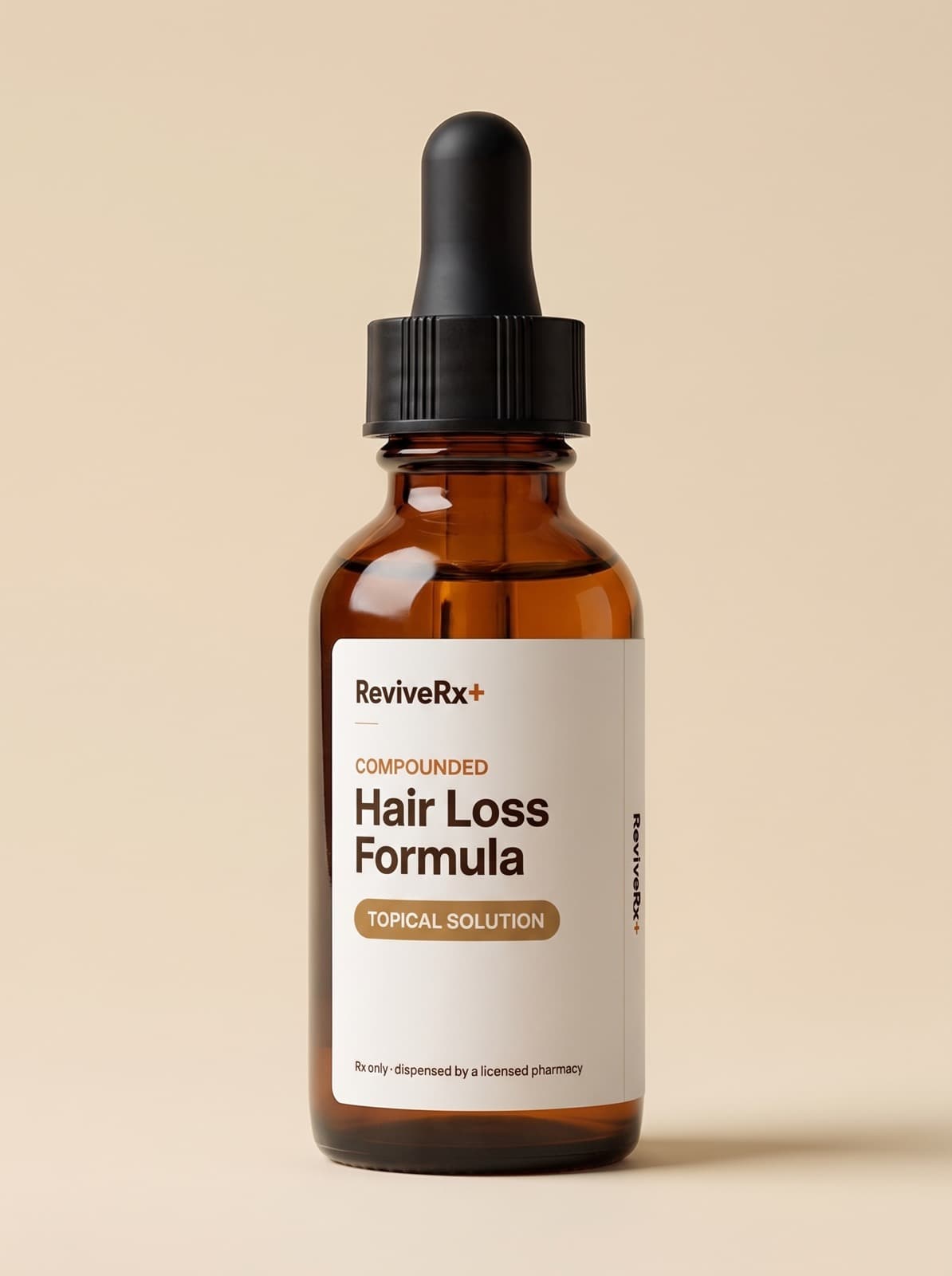
Compounded Hair Loss Formula
Compounded — daily topical solution or oral capsule
A pharmacy-prepared topical solution or oral capsule that combines the hair-loss medications your provider selects — finasteride, minoxidil and supporting ingredients — in one daily step, if prescribed.
Compounded hair loss formula is prepared for you by a licensed 503A compounding pharmacy and is not FDA-approved. It uses the active ingredients of FDA-approved brand-name and generic products (finasteride, minoxidil, tretinoin, ketoconazole, latanoprost, fluocinolone and, for women, spironolactone) but is not those products, and the FDA has not reviewed it for safety, effectiveness or quality.
From$159/mo$32 consultation included, not refunded · medication and shipping if prescribed
Choose your plan
4-week supply
Price
$159for a 4-week supply, if prescribed
Includes your $32 provider consultation (non-refundable). If your provider decides treatment isn’t appropriate, the medication portion is refunded automatically.
- Your provider confirms the dose. If they start you on a lower step, we refund the difference; if they choose a higher one within the same plan, the price you paid stands.
Adding to cart books a provider visit. You pay the shown total; the provider decides; the medication portion comes back automatically if they say no.
Questions
Will I definitely be prescribed this?
No. A consultation does not guarantee a prescription. A licensed provider reviews your history at the visit and decides whether this formula — and which ingredients in it — is appropriate for you. If they decline, the medication portion of what you paid is refunded automatically; the consultation fee is not.
Which form will I get — solution, capsule or tablet?
Your provider chooses from the pharmacy's order set. The topical solutions pair minoxidil with finasteride, or with tretinoin, fluocinolone, biotin and vitamin E (with or without finasteride). The oral capsule for men combines biotin, finasteride and a low dose of minoxidil; the oral tablet for women combines minoxidil, spironolactone and biotin. You tell the provider what you have tried and what you can realistically keep up with, and they pick.
Is this FDA-approved?
No. Compounded drugs are not FDA-approved — the FDA does not review them for safety, effectiveness or quality before they are dispensed. Each ingredient is the active ingredient of an approved medication, prepared for you by a licensed compounding pharmacy to your provider's prescription.
Why compounded, rather than the separate products?
Because several actives can go into one solution or one capsule, at the strengths your provider sets, and one daily step is easier to keep up than three. That is a convenience and an adherence argument, not a claim that the combination works harder — the combination itself has not been studied as a single product.
Why does it matter whether I am male or female?
The pharmacy runs two order sets. The women's set can include spironolactone, an anti-androgen that is not used in men, and a provider approaches finasteride differently in women of reproductive age because of the risk to a male fetus. Checkout asks your sex at birth so the visit is booked on the right set.
How it works
Pattern hair loss is driven by dihydrotestosterone (DHT) acting on genetically sensitive follicles, which shortens each growth cycle until the hair comes in finer and shorter. The formula attacks that from several directions at once. Finasteride inhibits 5-alpha-reductase, the enzyme that makes DHT; in a topical solution it works mainly where it is applied, with less of it reaching the bloodstream than the tablet. Minoxidil opens potassium channels and widens scalp blood vessels, lengthening the growth phase — it changes the follicle's timing rather than the hormone. For women, spironolactone blocks androgens at the receptor itself and is given as a daily tablet. The supporting ingredients each have a job: tretinoin, a retinoid, speeds skin cell turnover and helps the solution absorb; ketoconazole is an antifungal that reduces the scalp yeast and inflammation that irritate follicles; fluocinolone is a low-potency corticosteroid that calms the irritation the other actives can cause; latanoprost is a prostaglandin analogue whose label documents longer, thicker eyelashes, and its use on scalp hair is off-label with only small studies behind it. Biotin and vitamin E are vitamins, not drugs. The honest caveat: the single molecules have trial evidence; this particular combination has not been studied as one product, so your provider builds it from what each ingredient is known to do.
The full mechanismWhat the trials found
Published results, with what each was measured against.
These results come from trials of the FDA-approved product named in each citation. The compounded preparation on this page is not that product, was not studied in these trials, and has not been reviewed by the FDA for safety, effectiveness or quality.
Topical finasteride added about 20 hairs per square centimetre in the target area at 24 weeks
vs about 7 on placebo solution
458 men with male pattern hair loss randomised to a topical finasteride spray solution, placebo or oral finasteride for 24 weeks. Blood DHT fell less in the topical arm than the oral arm — the point of the topical route. The trial tested a single-ingredient solution, not this formula.
Piraccini et al., Journal of the European Academy of Dermatology and Venereology, 2022
Trial averages describe a study population, not a prediction for you. Your provider will be direct about what is realistic given your history — and results depend on continuing treatment.
A provider may consider it if
- You have early or moderate pattern thinning and want one daily step rather than three separate products
- You would rather apply a solution to the scalp than take a tablet, or you have tried a tablet and want the topical route discussed
- You are a woman with pattern thinning and your provider thinks an anti-androgen belongs in the plan
- You can keep it up for months — the mechanism only matters if you keep applying it
It won’t be prescribed if
- Anyone who is pregnant, breastfeeding or planning a pregnancy — finasteride and spironolactone can harm a male fetus, and minoxidil and tretinoin are not established as safe in pregnancy
- Women who may become pregnant and would be handling a finasteride-containing solution or capsule without reliable contraception
- Heart disease, low blood pressure or fluid retention, when oral minoxidil is in the formula — it was developed as a blood-pressure medication
- Kidney disease, high potassium or potassium supplements, when spironolactone is in the formula
- Sudden, patchy or unexplained hair loss, or a scalp that is red, inflamed, infected or broken — that needs a diagnosis, not a formula
- Anyone who had sexual side effects on finasteride before and is not willing to risk them again
- Under 18
These are the same checks your provider runs in the visit. If one applies, they will tell you plainly — and the medication portion of what you paid comes back automatically.
What to expect
Weeks 1–8
Some shedding is common as follicles in a resting phase cycle out, and it is not the formula failing. Mild scalp dryness, itching or redness is the usual early experience with the solution; a provider may adjust the strength.
Months 3–6
The earliest honest point to judge anything — hair grows slowly, and your provider will want photos or a straight description rather than a feeling.
Ongoing
The effect depends on continuing. Stopping lets the underlying process resume over the following months, which is why this is prescribed as a monthly supply and reviewed at check-ins.
Safety
Side effects, before you decide
With the solution: scalp itching, dryness, flaking or redness, and unwanted facial hair if it migrates — wash your hands after applying. Finasteride, even topically, is absorbed to some degree: a minority of men report reduced libido, erectile difficulty or changes in ejaculation, and breast tenderness or lumps should be reported promptly; persistent symptoms after stopping have been reported with the tablet. Spironolactone can cause irregular periods, breast tenderness, dizziness and a rise in blood potassium. Oral minoxidil can cause dizziness, a fast heartbeat, swelling of the hands or feet and unwanted body hair — chest pain or faintness means stop and call your provider. Tretinoin makes the scalp more sun-sensitive; a corticosteroid used for months can thin the skin; latanoprost can darken the skin or hair where it is applied.
- FDA prescribing information (DailyMed): Propecia (finasteride 1 mg) — initial US approval 1992, label revised 2022
- FDA Drug Facts (DailyMed): minoxidil topical solution 5 percent, hair regrowth treatment — over-the-counter label, read 2026
- FDA prescribing information (DailyMed): spironolactone tablets — label revised 2025
- FDA prescribing information (DailyMed): Retin-A (tretinoin) — label 2010; ketoconazole shampoo 2 percent — label revised 2026; Xalatan (latanoprost) — label revised 2022; fluocinolone acetonide topical solution 0.01 percent — label 2007
- Ho, Sood & Zito, Androgenetic Alopecia, StatPearls (NCBI Bookshelf), updated 2024
- Piraccini et al., Journal of the European Academy of Dermatology and Venereology, 2022 — phase III trial of a topical finasteride spray solution
Complete safety information is provided during your visit and with every prescription. This page is a summary, not a substitute for your provider's advice.
Also for hair
See whether compounded hair loss formula is right for you.
A licensed provider reviews your visit and decides. You receive medication only if prescribed, and that portion of your payment is refunded automatically if they say no.