Loading treatment…
Compounded — not FDA-approvedPrescription only
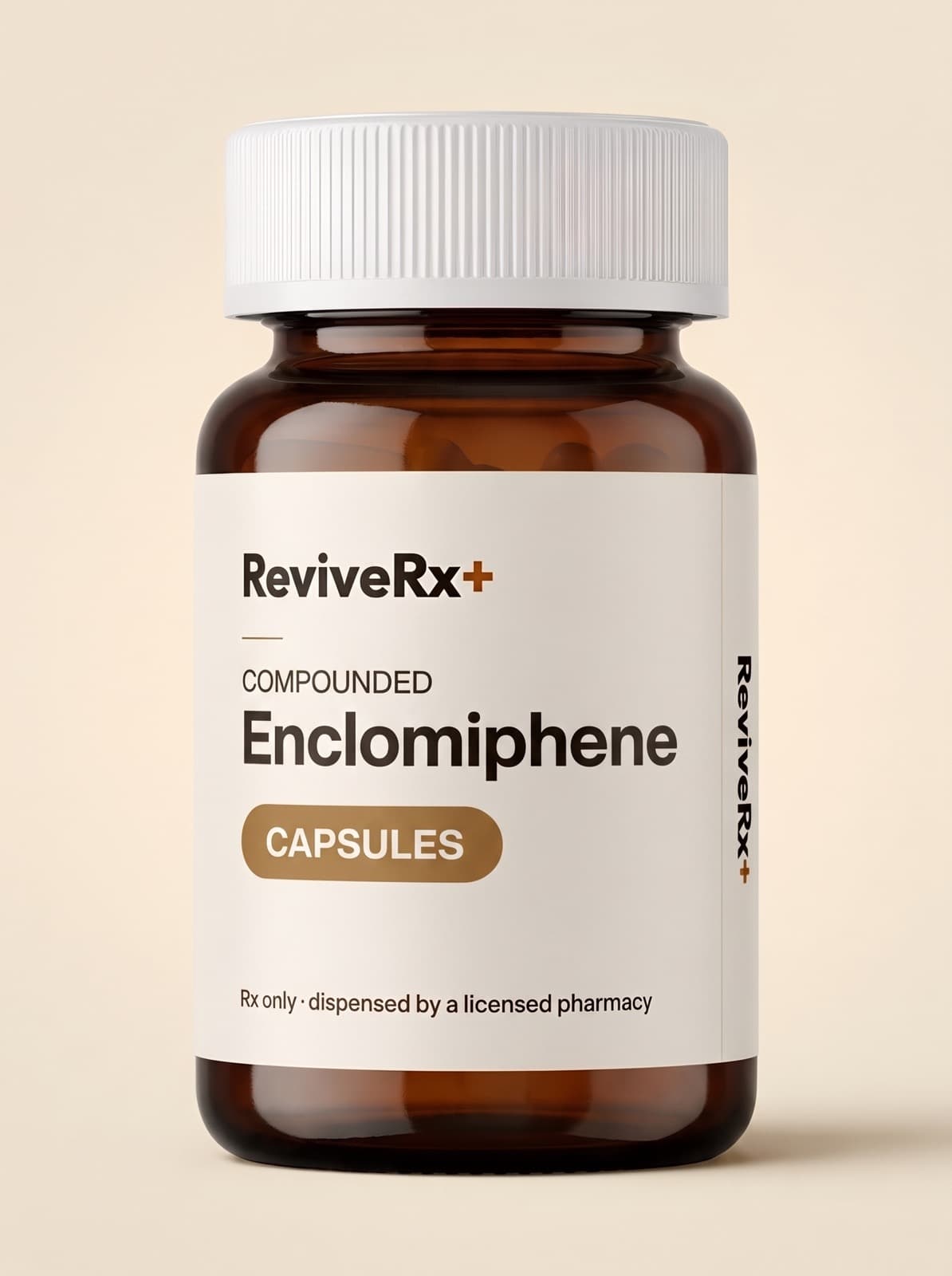
Compounded Enclomiphene
Compounded — daily oral, lab work required
A compounded daily tablet that prompts your own testes to make more testosterone by acting on the brain's oestrogen feedback — for men whose labs show secondary hypogonadism, and only after those labs are reviewed.
Enclomiphene is not an FDA-approved drug. It appears on FDA's list of bulk substances under evaluation for compounding (Category 1), which allows licensed pharmacies to compound it while FDA completes its review. Human outcome data is limited.
From$189$32 consultation included, not refunded · medication and shipping if prescribed
Choose your plan
One-time
Price
$189for this supply, if prescribed
Includes your $32 provider consultation (non-refundable). If your provider decides treatment isn’t appropriate, the medication portion is refunded automatically.
- This plan needs recent lab work. Your provider will tell you which results to upload before anything is prescribed.
- Your provider confirms the dose. If they start you on a lower step, we refund the difference; if they choose a higher one within the same plan, the price you paid stands.
Adding to cart books a provider visit. You pay the shown total; the provider decides; the medication portion comes back automatically if they say no.
Questions
Will I definitely be prescribed this?
No. A consultation does not guarantee a prescription, and this one starts with your lab work: no labs, no review. If your results do not show the secondary pattern, or your history carries one of the hard stops above, the provider declines and explains why. The medication portion is refunded; the consultation is not.
Why isn't there an approved version?
The company developing it, Repros, filed for approval in 2015 and FDA responded that the trial design was no longer adequate to show clinical benefit and asked for further studies, which were never run. In 2022 FDA's compounding advisory committee voted against adding enclomiphene to the list of substances pharmacies may compound from, mostly on the lack of efficacy evidence. It remains in the 'under evaluation' category today, which is the only reason it can be compounded at all, and that status could change.
How is this different from testosterone?
Testosterone replacement adds the hormone from outside; your own production and sperm count fall because the brain sees enough and stops asking. Enclomiphene asks your testes to make more, so the trials found sperm counts were preserved. Neither is right for everyone, and neither is prescribed here without labs.
Will this help with erections?
Not directly. Low testosterone can lower desire and contribute to erectile difficulty, but erections depend mostly on blood vessels and nerves, which enclomiphene does not act on. If ED is the main problem, a PDE5 inhibitor is the usual first conversation.
How it works
Enclomiphene is the trans-isomer of clomiphene, a selective oestrogen receptor modulator. In the hypothalamus and pituitary, oestrogen normally signals 'enough' and dampens the release of LH and FSH. Enclomiphene blocks that signal, so the pituitary releases more LH and FSH; LH tells the testes to make testosterone and FSH supports sperm production. That is why it is described as restoration rather than replacement: testosterone given from outside switches the same axis off and suppresses sperm production, whereas enclomiphene works only if your testes can still respond — it does nothing for primary testicular failure. There is no FDA-approved enclomiphene product; FDA declined the Androxal application in 2015 and asked for further trials that were never run, and its advisory committee voted in 2022 against adding it to the compounding list, so this is a substance under evaluation, not an established medicine.
The full mechanismWhat the trials found
Published results, with what each was measured against.
These results come from trials of the FDA-approved product named in each citation. The compounded preparation on this page is not that product, was not studied in these trials, and has not been reviewed by the FDA for safety, effectiveness or quality.
Testosterone rose into the normal range by week 16 while sperm concentration stayed in the normal range
vs testosterone gel, under which sperm concentration fell markedly
Two phase III randomised, double-blind, placebo-controlled trials in overweight men aged 18–60 with secondary hypogonadism (baseline testosterone at or below 300 ng/dL). Approval was still declined on trial-design grounds, so read this as mechanism confirmed, benefit unproven.
Kim ED, McCullough A, Kaminetsky J. BJU Int 2016;117(4):677–685
Trial averages describe a study population, not a prediction for you. Your provider will be direct about what is realistic given your history — and results depend on continuing treatment.
A provider may consider it if
- Recent lab work shows low morning testosterone with low or inappropriately normal LH — the secondary pattern this acts on
- You want to preserve fertility and sperm production, which testosterone replacement suppresses
- You are willing to repeat labs and be reviewed on them, not just on how you feel
It won’t be prescribed if
- Liver disease — clomiphene-class drugs are metabolised by the liver and are contraindicated in liver impairment
- Women, and anyone who is or could be pregnant — this exam is for men, and the clomiphene class is contraindicated in pregnancy
- A hormone-sensitive cancer, current or past — breast or prostate above all
- A history of blood clots, or of visual disturbances on clomiphene — both are known risks of the class
- Primary hypogonadism (testicular failure), an untreated pituitary or thyroid disorder, or anyone without recent lab work — there is nothing for it to act on, and nothing to review
These are the same checks your provider runs in the visit. If one applies, they will tell you plainly — and the medication portion of what you paid comes back automatically.
What to expect
Before review
Upload recent lab work — at minimum morning total testosterone, LH and FSH. The provider reviews it before deciding anything; without it there is no prescription.
Weeks 2–6
In the trials, testosterone rose into the normal range within about two weeks of daily dosing and LH and FSH rose with it. How you feel is a slower and less reliable signal than the labs.
Ongoing
Repeat labs and a check-in decide whether to continue, adjust or stop. Rising oestradiol, visual symptoms or mood changes are reasons to call, not to push through.
Safety
Side effects, before you decide
Headache, hot flushes, mood changes, irritability, acne and reduced libido are the reported ones for the clomiphene class; one small retrospective study found enclomiphene raised oestradiol less than clomiphene, but that comparison is thin. Visual disturbances — blurring, spots, light sensitivity — are a reason to stop and call. Blood clots are a rare but serious class risk. Long-term safety of enclomiphene on its own has not been established, which is part of why FDA's committee voted against it.
- Wiehle R, Cunningham GR, Pitteloud N, et al. BJU Int 2013;112(Suppl 4) — enclomiphene citrate in 48 men with secondary hypogonadism: pharmacodynamics and pharmacokinetics vs transdermal testosterone
- Wiehle RD, Fontenot GK, Wike J, et al. Fertil Steril 2014;102(3):720–727 — randomised phase II trial vs topical testosterone gel; sperm counts conserved
- Kim ED, McCullough A, Kaminetsky J. BJU Int 2016;117(4):677–685 — phase III trials ZA-304 / ZA-305 in overweight men with secondary hypogonadism
- Saffati G, Kassab J, Orozco Rendon D, et al. Transl Androl Urol 2024;13(9):1984–1990 — safety and efficacy of enclomiphene and clomiphene in 66 hypogonadal men, retrospective
- FDA Pharmacy Compounding Advisory Committee, enclomiphene citrate — briefing document and minutes, 2022-06-08
Complete safety information is provided during your visit and with every prescription. This page is a summary, not a substitute for your provider's advice.
See whether compounded enclomiphene is right for you.
A licensed provider reviews your visit and decides. You receive medication only if prescribed, and that portion of your payment is refunded automatically if they say no.