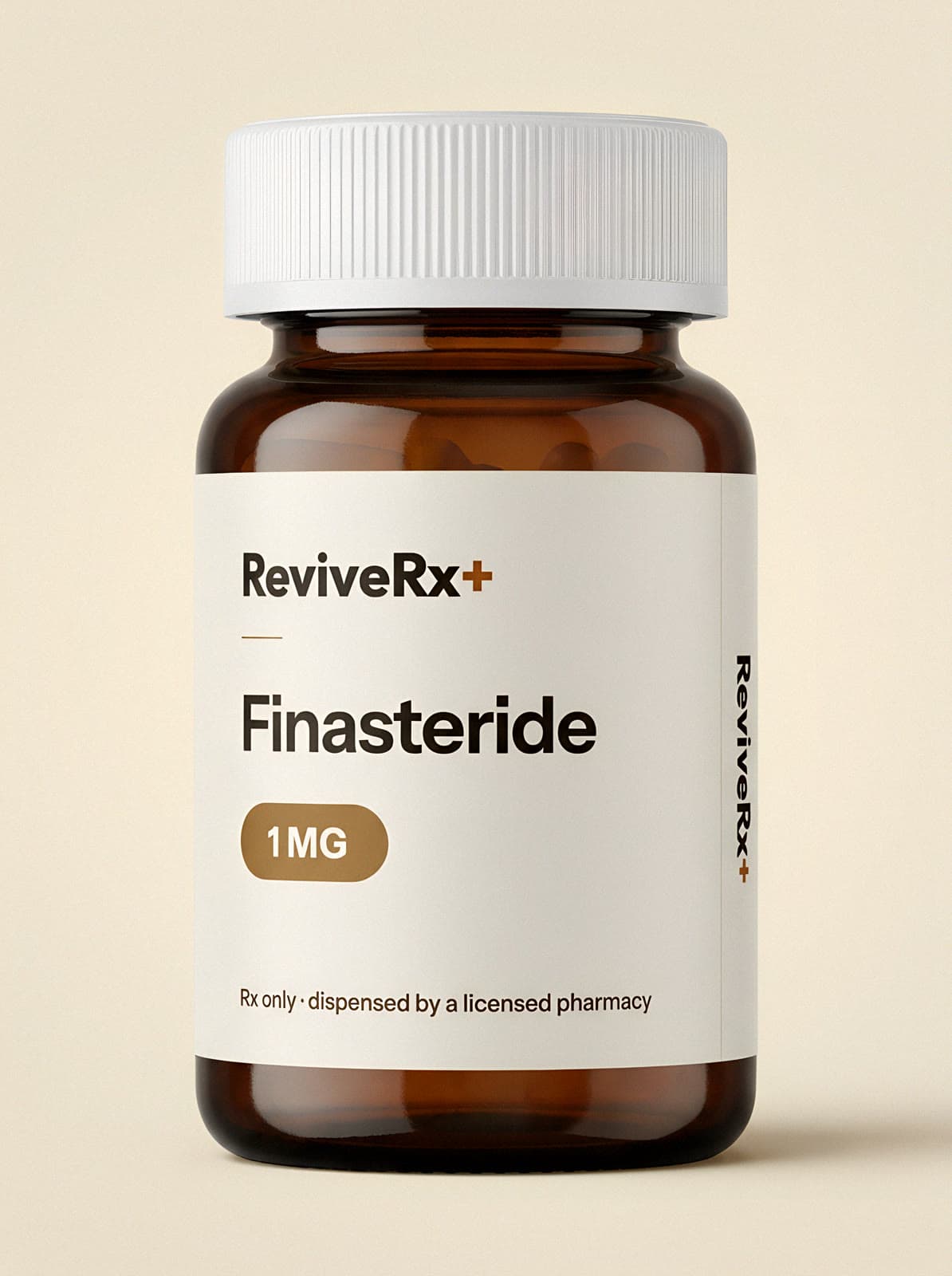
Finasteride
Ingredient of the Compounded Hair Loss Formula
Finasteride lowers DHT; on ReviveRxCare it may be prescribed as an ingredient in a compounded hair-loss formula.
Not sold here as a standalone treatment
This page explains Finasteride as an ingredient. ReviveRxCare does not currently offer it here as a standalone treatment; a provider may prescribe it as part of Compounded Hair Loss Formula.
How it works
FDA-approved for male pattern hair loss. Prescribed by a licensed provider only if appropriate for you.
An enzyme called 5-alpha-reductase converts testosterone into dihydrotestosterone (DHT). In follicles that are genetically sensitive to it, DHT shortens each growth cycle so the follicle produces a finer, shorter hair each time around. Finasteride inhibits that enzyme, lowering DHT and easing the pressure driving miniaturisation. It defends follicles that are still cycling — it cannot restore one that has stopped.
The full mechanismEvidence
What was studied, in whom, for how long, and compared with what.
About 83% of men had no further hair loss at 2 years
vs about 28% of men taking placebo
Measured by hair count in men with mild to moderate male pattern hair loss taking 1mg daily.
Kaufman et al., Journal of the American Academy of Dermatology, 1998; summarised in FDA labelling
Trial averages describe a study population, not a prediction for you. Your provider will be direct about what is realistic given your history — and results depend on continuing treatment.
Who it’s for
A provider may consider it when
- You're seeing early or moderate pattern loss and want to protect what's there
- You can commit to taking it daily — the effect depends on continuing
- You've discussed the sexual side effect profile honestly with a provider
Reasons it may not be prescribed
- Anyone who is pregnant, may become pregnant or is planning a pregnancy — finasteride can harm a male fetus, and a woman who is or may be pregnant should not handle crushed or broken tablets
- Anyone unwilling to accept the possibility of sexual side effects
- Hair loss that isn't pattern loss — scarring alopecia and other causes need a different route
- Under 18
These are the same checks your provider runs in the visit. If one applies, they will tell you plainly — and the medication portion of what you paid comes back automatically.
What to expect
Months 1–3
Nothing visible, and possibly some shedding as follicles cycle. This is the stage most people quit at, and quitting here is quitting before the mechanism has had time to matter.
Months 3–6
The earliest point at which change is typically assessed. Your provider will want photos or an honest description.
Ongoing
The effect depends on continuing. Stopping generally means losing the ground gained, over the following months.
Important safety information
A minority of men report reduced libido, erectile difficulty or reduced ejaculate volume; for most who experience them these resolve on stopping, though persistent symptoms have been reported. Breast tenderness, lumps or nipple discharge should be reported promptly. Finasteride also lowers the PSA blood test, which matters if you are ever screened for prostate cancer — tell any doctor ordering one. Your provider will discuss this fully before prescribing — it is not something to discover later.
- FDA prescribing information (DailyMed): Propecia (finasteride 1 mg) — initial US approval 1992, label revised 2022; pregnancy contraindication and handling precautions per that label
- Ho, Sood & Zito, Androgenetic Alopecia, StatPearls (NCBI Bookshelf), updated 2024
Complete safety information is provided during your visit and with every prescription. This page is a summary, not a substitute for your provider's advice.
Questions
Will I definitely be prescribed this?
No. A consultation does not guarantee a prescription. A licensed provider reviews your history, your pattern of loss and your risk factors, and prescribes finasteride only if it is appropriate for you — and may choose a formula without it.
Do I have to take it forever?
For as long as you want the effect. It's suppressing an ongoing hormonal process, not curing it — stop and the process resumes.
Why does timing matter so much?
Because treatment protects follicles that are still active. The earlier a provider reviews it, the more there is left to work with.
Not sold here on its own.
A provider can talk through what we do offer, and be straight about what would actually help.