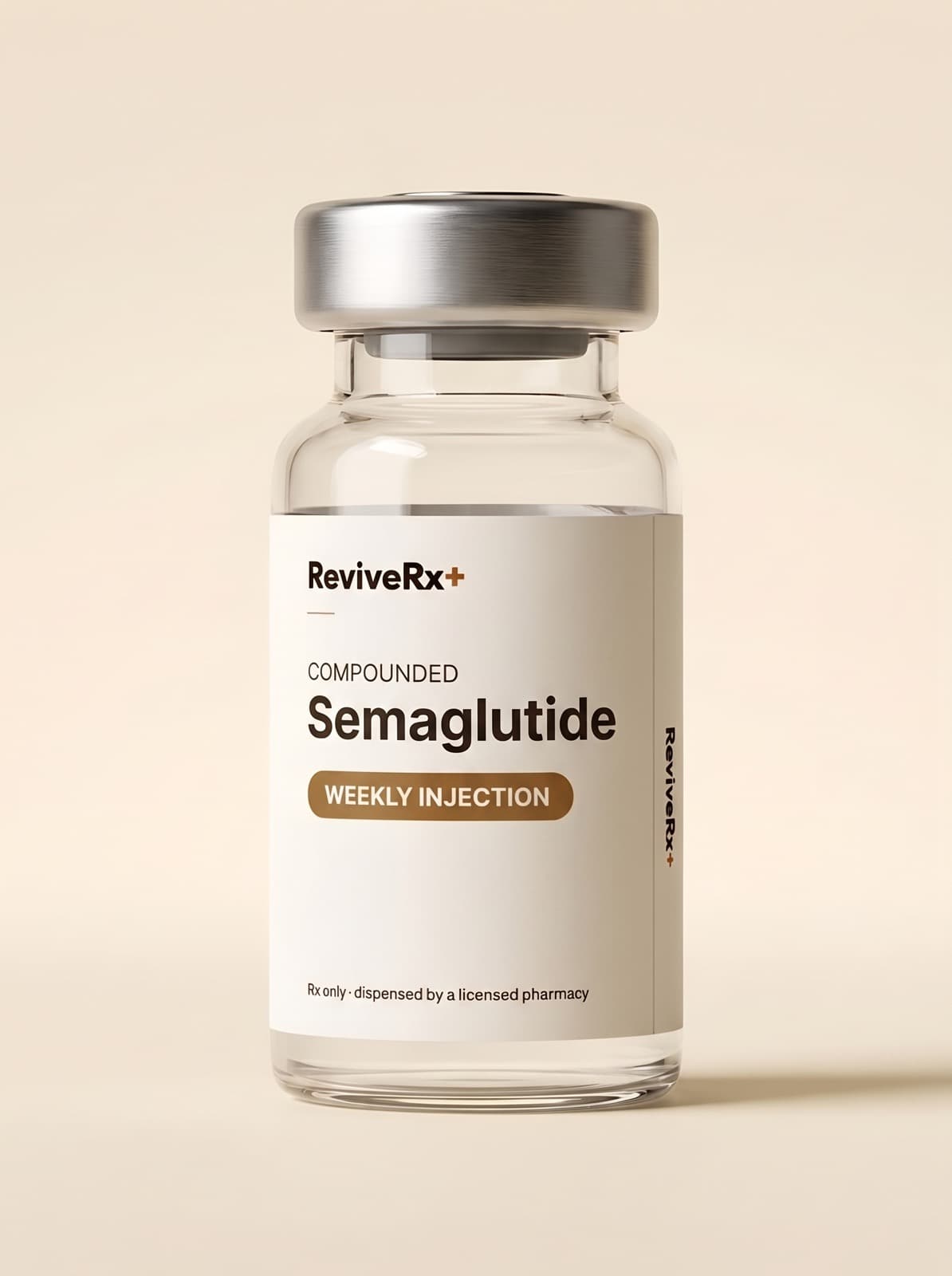
Compounded Semaglutide
Compounded — weekly injection
A GLP-1 medication injected weekly, prescribed for medical weight loss when a provider judges it appropriate.
From $169 4-week supply $32 consultation included, not refunded · medication and shipping if prescribed
Choose supply length
Price by strength
Your provider decides the strength.
Beginner · Steps 1–2
Intermediate · Steps 3–4
Advanced · Step 5
Not sure which strength?
Your provider decides the strength.
$169 for a 4-week supply, if prescribed
Includes your $32 provider consultation (non-refundable). If your provider decides treatment isn’t appropriate, the medication portion is refunded automatically.
- Compounded semaglutide, tirzepatide and liraglutide are not prescribed in Ohio or Washington, and we have no other weight-loss medication to offer there, so weight-loss care isn't available in either state.
- Your provider decides which strength, if any, is appropriate for you. If they prescribe a lower strength than the one you paid for, we refund the difference automatically. If they prescribe a higher strength, we ask you to approve the difference in price before the higher-strength order can move forward, and nothing more is charged without your approval. If you decline, we ask your provider to review whether the strength you paid for is appropriate; if they do not prescribe it, the item is not sent and the medication portion is refunded.
Paying books a visit with a licensed provider, who decides whether to prescribe and which strength is appropriate. If nothing is prescribed, the medication portion is refunded automatically; a higher strength costs more only if you approve that charge.
How it works
Compounded semaglutide is prepared for you by a licensed compounding pharmacy in our clinical partner's network and is not FDA-approved. It is not a brand-name or generic product, and the FDA has not reviewed it for safety, effectiveness or quality. A provider may prescribe it only where they document a clinical reason it is right for you specifically.
Semaglutide resembles GLP-1, a hormone your intestine releases after eating that signals fullness to the brain and helps regulate insulin. Natural GLP-1 breaks down within minutes; semaglutide resists the enzyme that clears it, so the fullness signal keeps arriving between meals. It also slows how quickly the stomach empties — which is why smaller meals satisfy, and also why nausea is the most common side effect.
The full mechanismEvidence
What was studied, in whom, for how long, and compared with what.
These results come from trials of the FDA-approved product named in each citation. The compounded preparation on this page is not that product, was not studied in these trials, and has not been reviewed by the FDA for safety, effectiveness or quality.
14.9% mean body-weight reduction
vs 2.4% on placebo
Over 68 weeks at 2.4mg weekly, alongside lifestyle intervention, in adults with overweight or obesity without diabetes.
Wilding et al., STEP 1 trial, New England Journal of Medicine, 2021
Trial averages describe a study population, not a prediction for you. Your provider will be direct about what is realistic given your history — and results depend on continuing treatment.
Who it’s for
A provider may consider it when
- You want a medical approach rather than another diet
- You're willing to check in with a provider as the dose is adjusted
- You understand this is a long-term treatment, not a short course
Reasons it may not be prescribed
- Anyone with a personal or family history of medullary thyroid carcinoma, or MEN 2 syndrome — this is a hard stop
- Pregnancy, trying to become pregnant, or breastfeeding
- A history of pancreatitis, without careful provider review
- Type 1 diabetes, gastroparesis, or an active eating disorder without in-person care
These are the same checks your provider runs in the visit. If one applies, they will tell you plainly — and the medication portion of what you paid comes back automatically.
What to expect
Weeks 1–4
The starting dose is deliberately low — low enough that it isn't expected to do much yet. It's there to let your gut adapt.
Months 1–4
Your provider steps the dose up gradually, checking how you're tolerating it at each stage. The ramp is the treatment, not a delay before it.
Ongoing
Dose and plan are revisited at check-ins. Stopping generally means the appetite effects stop too — this is managed as an ongoing condition.
Important safety information
Nausea, vomiting, diarrhea, constipation and reflux are the common ones, usually worst just after a dose increase. Serious but uncommon risks include pancreatitis, gallbladder problems and kidney injury from dehydration. Your provider goes through the full list before prescribing, and complete information comes with every prescription.
- Wegovy (semaglutide) prescribing information, DailyMed, revised 2026-06-18 — boxed warning: thyroid C-cell tumours in rodents; contraindicated with a personal or family history of MTC or MEN 2
- Wilding JPH et al., STEP 1 trial, New England Journal of Medicine, 2021
Complete safety information is provided during your visit and with every prescription. This page is a summary, not a substitute for your provider's advice.
Questions
Is anything added to the semaglutide?
It depends on the supply and on your state, because the pharmacy that fills it differs. The 12-week supply has vitamin B12 added, in every state. The 4-week supply has vitamin B12 added in Arkansas, California, Hawaii, Kansas, Maryland, Massachusetts, Michigan and Minnesota, and is semaglutide alone everywhere else. The pharmacy label lists exactly what you receive.
Also for weight loss
$32 consultation included, not refunded · medication and shipping if prescribed

See whether Compounded Semaglutide is right for you.
A licensed provider reviews your visit and decides. You receive medication only if prescribed, and that portion of your payment is refunded automatically if they say no.