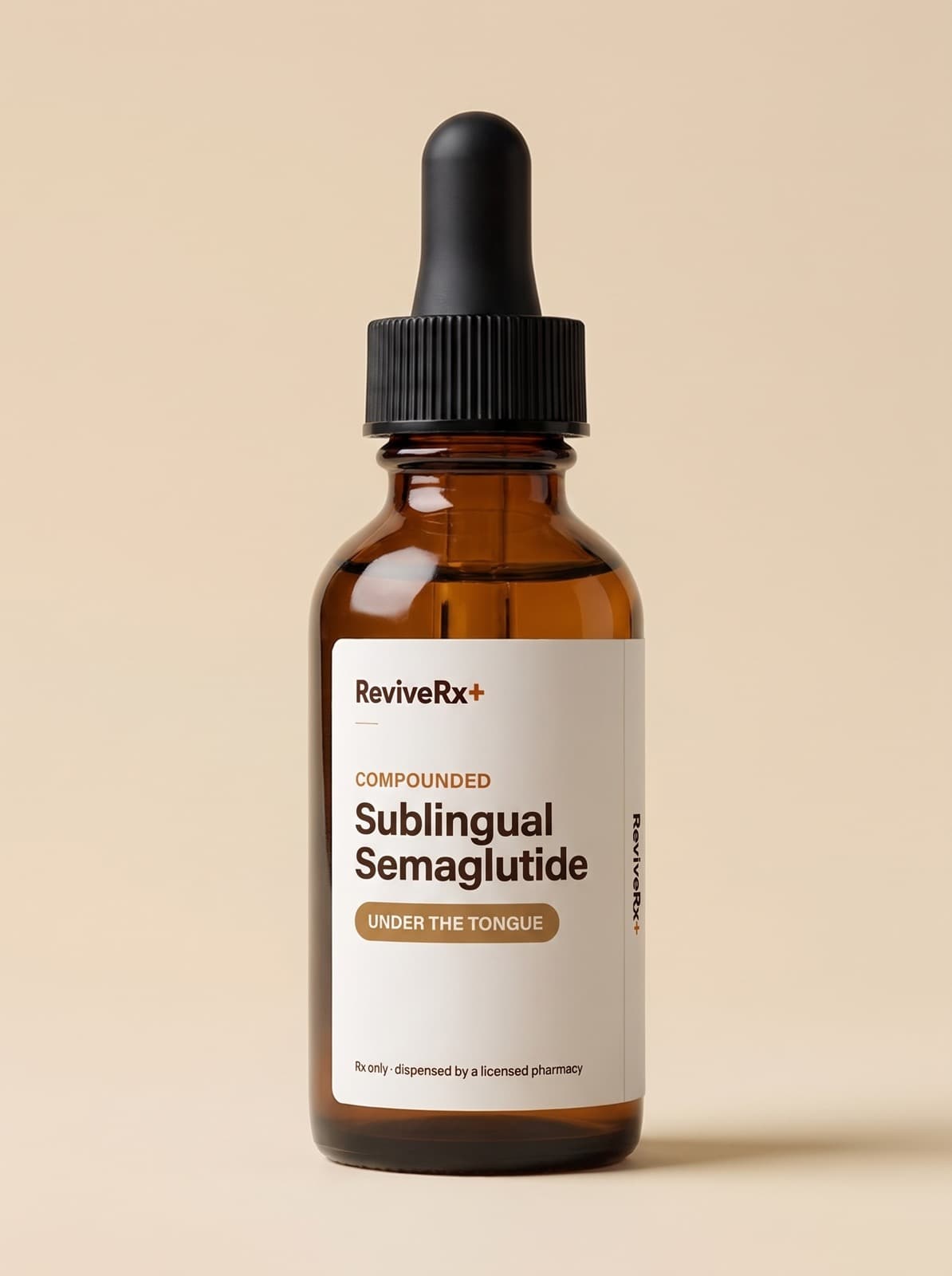
Compounded Sublingual Semaglutide
Compounded — daily under-the-tongue dose
A daily semaglutide dose held under the tongue — no published human evidence it works like the injection.
From $179 4-week supply $32 consultation included, not refunded · medication and shipping if prescribed
Choose supply length
Price
$179 for a 4-week supply, if prescribed
Includes your $32 provider consultation (non-refundable). If your provider decides treatment isn’t appropriate, the medication portion is refunded automatically.
- Not available in California.
- Compounded semaglutide, tirzepatide and liraglutide are not prescribed in Ohio or Washington, and we have no other weight-loss medication to offer there, so weight-loss care isn't available in either state.
Paying books a visit with a licensed provider, who decides whether to prescribe and which strength is appropriate. If nothing is prescribed, the medication portion is refunded automatically; a higher strength costs more only if you approve that charge.
How it works
Compounded sublingual semaglutide is prepared for you by a licensed compounding pharmacy in our clinical partner's network and is not FDA-approved. It is not a brand-name or generic product, and the FDA has not reviewed it for safety, effectiveness or quality. A provider may prescribe it only where they document a clinical reason it is right for you specifically.
Semaglutide resembles GLP-1, a gut hormone released after eating that signals fullness to the brain, slows stomach emptying and helps regulate insulin. What differs from the weekly injection is the route. A sublingual dose is held under the tongue so that some of it can cross the lining of the mouth into the bloodstream, and the rest is swallowed. Semaglutide is a large peptide, and large peptides cross that lining poorly — which is why the approved oral form is a tablet built around an absorption enhancer and taken on an empty stomach. How much of a compounded sublingual dose actually reaches the blood in people has not been published: the only pharmacokinetic study of the route is a single-dose study in rats. Your provider will tell you that before prescribing it, not after.
The full mechanismWho it’s for
A provider may consider it when
- You would rather not inject, and you accept that the sublingual route has no published human outcome data
- You've had a frank conversation with your provider about why this form rather than the injection or the approved tablet
- You can take a dose at the same time every day and hold it under the tongue for as long as the pharmacy's instructions say
Reasons it may not be prescribed
- Anyone with a personal or family history of medullary thyroid carcinoma, or MEN 2 syndrome — a hard stop for every semaglutide product, whatever the route
- Pregnancy, trying to become pregnant, or breastfeeding
- A history of pancreatitis, without careful provider review
- Type 1 diabetes, gastroparesis, or an active eating disorder without in-person care
- Anyone choosing on evidence alone — the published trials are of the injection, and your provider will say so
These are the same checks your provider runs in the visit. If one applies, they will tell you plainly — and the medication portion of what you paid comes back automatically.
What to expect
Before you start
Your provider explains the evidence gap: the weekly injection has large published trials; the sublingual form has none in people. If that changes your mind, the injection is on the same account.
Weeks 1–4
A low starting dose taken daily under the tongue while your gut adapts. Nausea, if it comes, tends to follow dose increases, as it does with the injection.
Ongoing
Dose and form are revisited at check-ins. If the sublingual route is not doing what you and your provider hoped, switching to the injection is a normal clinical decision, not a failure.
Important safety information
The semaglutide class effects apply whatever the route: nausea, vomiting, diarrhea, constipation and reflux, usually worst after a dose increase, with pancreatitis, gallbladder problems and kidney injury from dehydration as the serious but uncommon risks. The sublingual route adds its own unknowns — how much is absorbed, and how consistently, has not been measured in people — and it can irritate the mouth. The boxed warning on thyroid C-cell tumours seen in rodents applies to every semaglutide product.
- Wegovy (semaglutide) prescribing information — injection and tablets; DailyMed, revised 2026-06-18
- Liu Y, Song G, Banov D, Denison J, Davis C, Ip K. Single-dose pharmacokinetics of sublingual semaglutide in rats. European Journal of Pharmaceutical Sciences, 2026 — the only published pharmacokinetic study of the route; preclinical, no human data
- FDA, 'FDA's concerns with unapproved GLP-1 drugs used for weight loss', updated 2026-09-01 — compounded GLP-1 products are not reviewed for safety, effectiveness or quality; dosing-error and adverse-event reports
Complete safety information is provided during your visit and with every prescription. This page is a summary, not a substitute for your provider's advice.
Questions
Will I definitely be prescribed this?
No — a consultation does not guarantee a prescription. A licensed provider reviews your health history, and since the shortage ended a compounding pharmacy may prepare semaglutide for you only where the prescriber documents a clinical reason it is right for you specifically. If that reason isn't there, you'll be told why and the medication portion of your payment is refunded.
Does the sublingual form work as well as the injection?
Nobody can tell you that honestly, because it has not been studied in people. The weekly injection has large randomised trials behind it; the sublingual form has a single-dose study in rats and no published human outcome data. We list it because some patients and providers choose it with that understood — not because the evidence is there.
Isn't there an approved semaglutide tablet?
Yes. Wegovy is now also made as a once-daily tablet, formulated with an absorption enhancer and taken on an empty stomach with a wait before food. A compounded sublingual product is not that tablet — it is a different formulation that the FDA has not reviewed. Your provider can talk through both.
What is actually in the sublingual dose?
Semaglutide with methylcobalamin, a form of vitamin B12, as a tablet that dissolves under the tongue: that is what the pharmacy that fills it prepares, in every state where it is offered. The pharmacy label tells you exactly what you receive and how to take it.
Also for weight loss
$32 consultation included, not refunded · medication and shipping if prescribed
See whether Compounded Sublingual Semaglutide is right for you.
A licensed provider reviews your visit and decides. You receive medication only if prescribed, and that portion of your payment is refunded automatically if they say no.