Loading treatment…
Compounded — not FDA-approvedPrescription only
Compounded DSIP (Delta Sleep-Inducing Peptide)
Compounded — self-administered injection
A compounded injection of a nine-amino-acid peptide isolated from rabbit blood in 1977 and proposed as a sleep factor. The human data is still inconsistent, and FDA's committee voted against compounding it.
DSIP (emideltide) is not an FDA-approved drug and is not currently on FDA's list of substances that may be used in compounding. FDA's advisory committee voted against its inclusion on 2026-07-24; its status may change and this treatment may be withdrawn. Your provider decides whether it is appropriate for you.
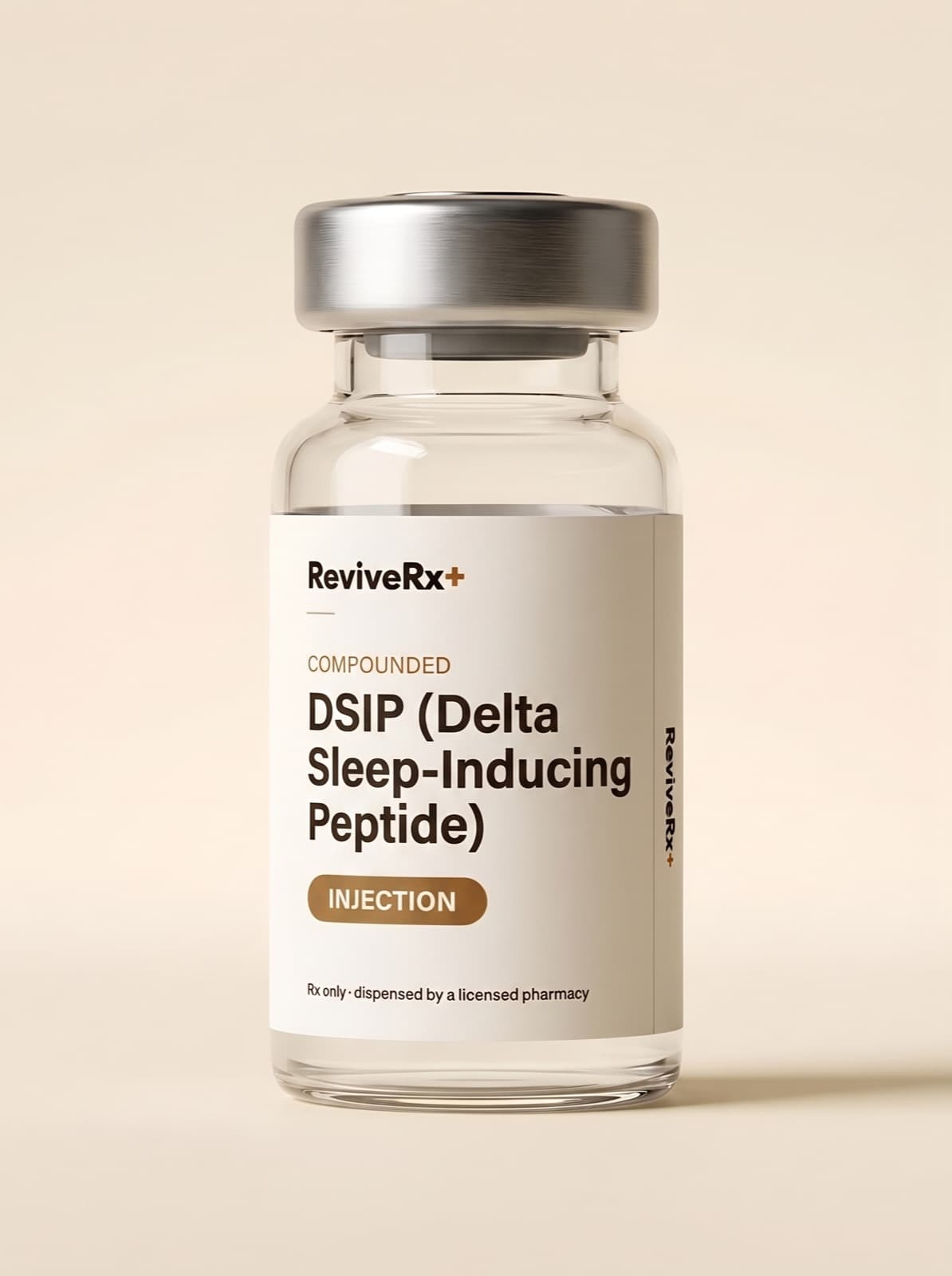
Not priced on the site yet
Compounded DSIP (Delta Sleep-Inducing Peptide) is on the formulary, but its price isn’t published here yet — so it can’t be added to a cart. The medications with a published price are listed by category.
See peptides optionsQuestions
Will I definitely be prescribed this?
No. A consultation does not guarantee a prescription. A licensed provider reviews your history at the visit and decides whether this is appropriate for you; because the substance is not on FDA's list for compounding and the human data is thin, many providers will reasonably decline. If they decline, the medication portion of what you paid is refunded automatically; the consultation fee is not.
Is this FDA-approved?
No. Compounded drugs are not FDA-approved, and DSIP is not the active ingredient of any approved product. In July 2026 FDA's advisory committee voted against adding it to the list of substances pharmacies may compound, by a single vote, after FDA staff said the safety and effectiveness data were lacking. It has no lawful basis on that list today.
Could this be withdrawn?
Yes. Its regulatory status can change at any time: FDA's advisory committee vote is a recommendation, FDA's own rulemaking decides the list, a state pharmacy board can act on its own, and our partner pharmacy can stop preparing it. If any of that happens we stop offering it, tell you, and refund the medication portion of any order the pharmacy can no longer fill.
Will it make me sleep?
We cannot promise that, and the evidence would not support the promise. Native DSIP had weak and inconsistent effects on sleep in the studies that exist, which is one reason FDA's advisory committee voted against it. If your sleep problem has not been evaluated, that is the first step — and it is one we would take before anyone prescribes this.
Why is it still sold if the evidence is this thin?
Because the 1977 discovery was genuinely exciting, the name promises exactly what people want, and compounding pharmacies can prepare it for a prescription. None of that is evidence. We list it because it is on our provider's account and we would rather you read this page than a forum; whether a provider prescribes it to you is their call, and many will decline.
How it works
Delta sleep-inducing peptide is the nonapeptide Trp-Ala-Gly-Gly-Asp-Ala-Ser-Gly-Glu, isolated in Basel in 1977 from the blood of rabbits kept in slow-wave sleep and named for what it appeared to do. The idea was that it promotes delta — deep, slow-wave — sleep by acting on the brain's sleep-regulating circuits, and later work proposed effects on stress hormones and on withdrawal states. The problem, stated plainly by the neurochemists who reviewed it in 2006, is that the gene, the protein precursor and the receptor for DSIP have never been found; its very existence as a natural signalling molecule is uncertain, its sleep effect in people was weak and inconsistent across studies, and modified analogues worked where the original did not. That is why FDA's staff told the committee in July 2026 that safety and effectiveness data were lacking for insomnia, narcolepsy and opioid use disorder, and why the committee voted against it. A provider who prescribes it is working from a 1970s hypothesis, not from evidence.
The full mechanismA provider may consider it if
- Sleep quality is what you are working on with a provider who has already looked for the ordinary causes — apnoea, caffeine, alcohol, mood, medication timing
- You are comfortable with subcutaneous self-injection after instruction
- You understand that the evidence is weak and contradictory and that FDA's committee said so
It won’t be prescribed if
- Pregnancy, breastfeeding or trying to conceive
- Active cancer, without your oncologist involved
- Anyone taking opioids, benzodiazepines, sleeping tablets or other sedatives, or drinking alcohol in the evening — interactions with a sedating peptide have not been studied
- Suspected sleep apnoea — loud snoring, gasping in sleep or daytime sleepiness need a sleep study, not a peptide
- A psychiatric or seizure disorder under treatment, without that prescriber involved
- Under 18
These are the same checks your provider runs in the visit. If one applies, they will tell you plainly — and the medication portion of what you paid comes back automatically.
What to expect
Weeks 1–2
Injection-site redness or tenderness is the common early experience. Some people report drowsiness or headache after an evening dose.
Weeks 2–4
Human outcome data is limited and inconsistent — the studies that exist disagree with each other — so your provider will ask what you notice rather than tell you what to expect.
Ongoing
Reviewed at check-ins. FDA's committee voted against it, so the likelier direction for its status is off the market rather than on; if that happens we stop offering it and tell you.
Safety
Side effects, before you decide
Injection-site redness, tenderness or bruising are the common ones. Drowsiness, headache, dizziness and nausea are reported. Because the human studies are small, old and contradictory, the true rate of anything — and whether it interacts with sedatives, opioids or alcohol — is unknown. Human outcome data is limited, and long-term safety data does not exist.
- Kovalzon VM, Strekalova TV. J Neurochem 2006;97(2):303–309 — delta sleep-inducing peptide, a still unresolved riddle: no gene, precursor or receptor identified; weak and inconsistent sleep effects in humans
- Graf MV, Kastin AJ. Peptides 1986;7(6):1165–1187 — DSIP: an update on its isolation, proposed actions and the state of the sleep data
Complete safety information is provided during your visit and with every prescription. This page is a summary, not a substitute for your provider's advice.
Also for peptides
 Compounded CJC-1295 / Ipamorelin
From$199/mo$32 consultation included, not refunded · medication and shipping if prescribed
 Compounded Tesamorelin / Ipamorelin
 Compounded MOTS-c
From$239/mo$32 consultation included, not refunded · medication and shipping if prescribed
 Compounded MOTS-c / Tesamorelin
 Compounded Epithalon
From$349/12 wk$32 consultation included, not refunded · medication and shipping if prescribed
 Compounded Epithalon / GHK-Cu
From$219/mo$32 consultation included, not refunded · medication and shipping if prescribed
 Compounded Semax / Selank
 Compounded Thymosin Alpha-1
 Compounded Pinealon / PE-22-28 / Selank
See whether compounded dsip (delta sleep-inducing peptide) is right for you.
A licensed provider reviews your visit and decides. You receive medication only if prescribed, and that portion of your payment is refunded automatically if they say no.