Loading treatment…
Compounded — not FDA-approvedPrescription only
Compounded Pinealon / PE-22-28 / Selank
Compounded — nasal spray
A compounded nasal spray combining pinealon, a tripeptide studied in rat neurons, PE-22-28, a spadin fragment from mouse depression models, and selank, a Russian anxiolytic peptide. None has a human trial in English.
Pinealon, PE-22-28 and selank are not FDA-approved drugs and are not currently on FDA's list of substances that may be used in compounding. FDA's advisory committee has not reviewed any of them — as of 2026-09-13 pinealon and PE-22-28 have never been nominated and selank has never been scheduled; their status may change and this treatment may be withdrawn. Your provider decides whether it is appropriate for you.
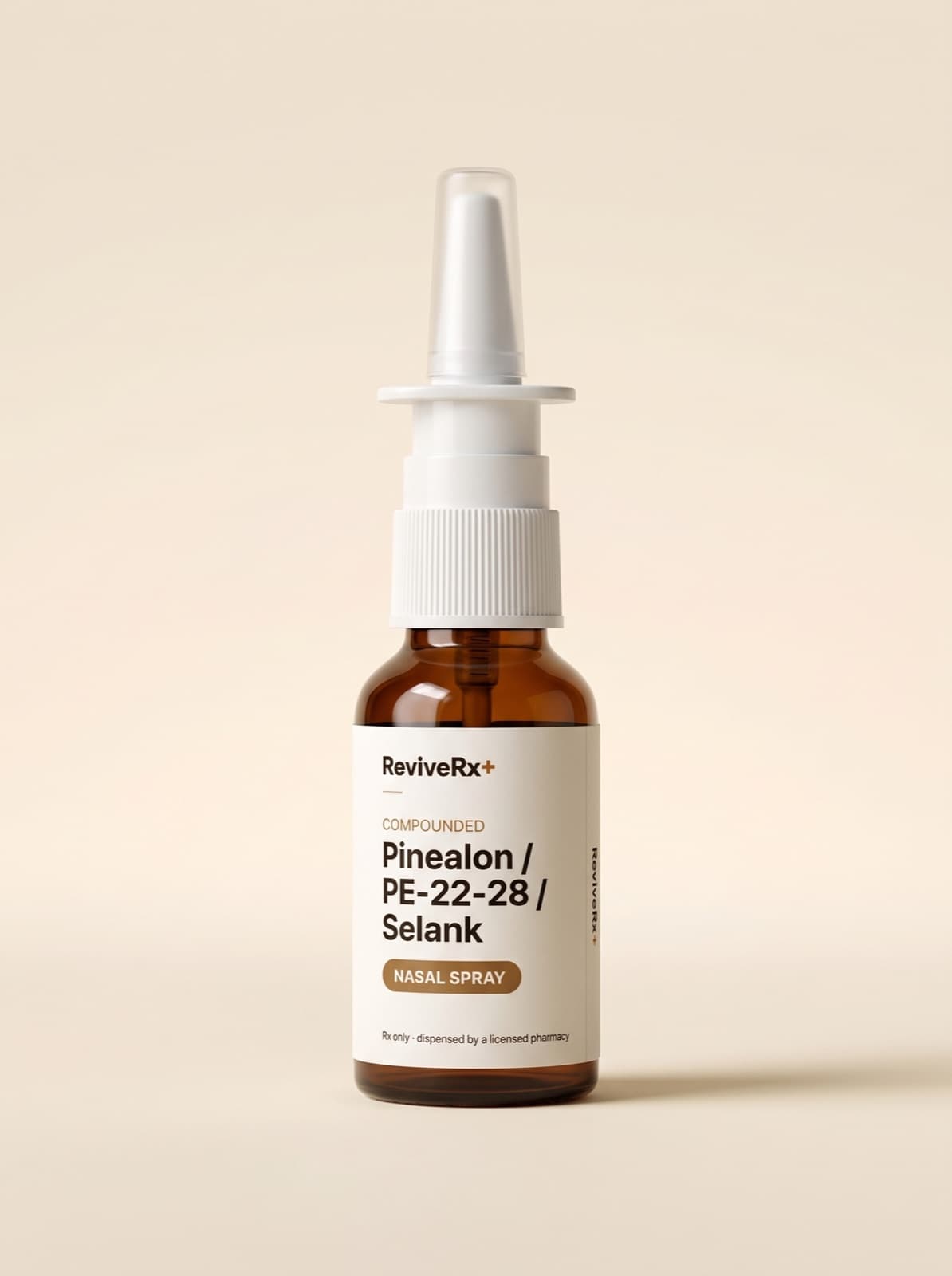
Not priced on the site yet
Compounded Pinealon / PE-22-28 / Selank is on the formulary, but its price isn’t published here yet — so it can’t be added to a cart. The medications with a published price are listed by category.
See peptides optionsQuestions
Will I definitely be prescribed this?
No. A consultation does not guarantee a prescription. A licensed provider reviews your history at the visit and decides whether this is appropriate for you; because the substance is not on FDA's list for compounding and the human data is thin, many providers will reasonably decline. If they decline, the medication portion of what you paid is refunded automatically; the consultation fee is not.
Is this FDA-approved?
No. Compounded drugs are not FDA-approved, and none of pinealon, PE-22-28 or selank is the active ingredient of any approved product. None of the three has even been nominated to or scheduled for FDA's compounding advisory committee, so there is no recommendation of any kind behind them. FDA has not reviewed any of them, or this combination, for safety, effectiveness or quality.
Could this be withdrawn?
Yes. Its regulatory status can change at any time: FDA's advisory committee vote is a recommendation, FDA's own rulemaking decides the list, a state pharmacy board can act on its own, and our partner pharmacy can stop preparing it. If any of that happens we stop offering it, tell you, and refund the medication portion of any order the pharmacy can no longer fill.
What is PE-22-28?
A seven-amino-acid piece of spadin, a peptide the body makes from a larger protein. Spadin blocks a potassium channel called TREK-1, and blocking that channel has antidepressant-like effects in mice; the shortened fragment was designed in 2017 to block it more strongly and last longer in the blood. That is the entire story — a mechanism and a mouse result. No person has taken it in a published study.
Why does this have the least behind it of anything you list?
Because two of its three ingredients have never been given to a person in a published study and the third has never been nominated to FDA. Every other peptide here at least has an advisory-committee record, for or against. This one has nothing — which is why we say so on the page, and why a provider may well decline.
How it works
Pinealon is the tripeptide Glu-Asp-Arg, from the same St Petersburg laboratory that produced epithalon; in cultured rat neurons and in aged or stressed rats it lowered free-radical levels and supported cell survival, and its proposed mechanism is direct interaction with DNA to change gene expression — a claim made from laboratory work, not from any study in people. PE-22-28 is a seven-amino-acid fragment of spadin, a natural peptide that blocks the TREK-1 potassium channel in neurons; blocking that channel is a proposed antidepressant mechanism, and in mice the shortened fragment produced antidepressant-like behaviour within days and stayed active far longer than spadin itself — again, in mice. Selank is a synthetic tuftsin analogue used in Russia for anxiety, acting on GABA signalling and on the enzymes that break down the body's own enkephalins. The nasal route places all three near the olfactory nerve. The combination is a cognition-plus-mood idea assembled from three separate animal literatures: there is no human trial of pinealon or PE-22-28 in English at all, none of the three has been nominated to FDA's committee, and no study of the mixture exists.
The full mechanismA provider may consider it if
- Focus and mood under stress are what you are working on with a provider who has already ruled out the ordinary causes and any condition that needs its own treatment
- You would rather use a nasal spray than inject anything
- You understand that every ingredient here rests on animal or Russian-language work and that this is an experiment with a provider, not an established treatment
It won’t be prescribed if
- Pregnancy, breastfeeding or trying to conceive
- Active cancer, without your oncologist involved
- Anyone taking benzodiazepines, sleeping tablets or other sedatives, or with a history of alcohol or substance dependence — selank acts on GABA and enkephalin systems, and a 2021 review flagged dependence potential for the class
- Depression or any other psychiatric condition under treatment, without that prescriber involved — PE-22-28 targets an antidepressant mechanism in mice and cannot stand in for treatment in a person
- Under 18
These are the same checks your provider runs in the visit. If one applies, they will tell you plainly — and the medication portion of what you paid comes back automatically.
What to expect
Days 1–7
Nasal irritation, dryness or a bitter taste is the common early experience with any peptide spray. Selank can make some people drowsy and others restless.
Weeks 2–4
Human outcome data is limited to none for two of the three ingredients and to Russian-language studies for the third, so there is no timeline to borrow — your provider will ask what you notice.
Ongoing
Reviewed at check-ins. None of the three has any FDA recommendation; if a pharmacy board or our partner pharmacy changes its position we stop offering it and tell you.
Safety
Side effects, before you decide
Nasal irritation, dryness, sneezing, a bitter taste and headache are the common ones for a peptide nasal spray. Selank can cause drowsiness or, in some people, restlessness. For pinealon and PE-22-28 no human safety data exists at all — their side-effect profile in people is simply unknown. Human outcome data is limited, and a 2021 pharmacology review warned that GABA-acting compounds carry a risk of dependence with chronic use.
- Khavinson V, Ribakova Y, Kulebiakina K, et al. Rejuvenation Res 2011;14(5):535–541 — pinealon (Glu-Asp-Arg) and cell viability, free-radical levels and proliferation in cultured cells
- Mendzheritsky AM, Karantysh GV, Ryzhak GA, Dem'yanenko SV. Adv Gerontol 2015;28(3):532–539 — pinealon and cortexin in 18-month-old rats under hypoxia and hypothermia
- Djillani A, Pietri M, Moreno S, Heurteaux C, Mazella J, Borsotto M. Front Pharmacol 2017;8:643 — shortened spadin analogues including PE 22-28: TREK-1 inhibition, in vivo stability and antidepressant-like activity in mice
- Doyno CR, White CM. J Clin Pharmacol 2021;61(Suppl 2):S114–S128 — review of GABA-acting compounds including selank
Complete safety information is provided during your visit and with every prescription. This page is a summary, not a substitute for your provider's advice.
Also for peptides
 Compounded CJC-1295 / Ipamorelin
From$199/mo$32 consultation included, not refunded · medication and shipping if prescribed
 Compounded Tesamorelin / Ipamorelin
 Compounded MOTS-c
From$239/mo$32 consultation included, not refunded · medication and shipping if prescribed
 Compounded MOTS-c / Tesamorelin
 Compounded Epithalon
From$349/12 wk$32 consultation included, not refunded · medication and shipping if prescribed
 Compounded Epithalon / GHK-Cu
From$219/mo$32 consultation included, not refunded · medication and shipping if prescribed
 Compounded Semax / Selank
 Compounded DSIP (Delta Sleep-Inducing Peptide)
 Compounded Thymosin Alpha-1
See whether compounded pinealon / pe-22-28 / selank is right for you.
A licensed provider reviews your visit and decides. You receive medication only if prescribed, and that portion of your payment is refunded automatically if they say no.