Loading treatment…
Compounded — not FDA-approvedPrescription only
Compounded Thymosin Alpha-1
Compounded — self-administered injection
A compounded injection of a 28-amino-acid peptide the thymus makes to mature T cells, registered abroad as Zadaxin for hepatitis and as a vaccine adjunct. FDA's committee voted 4 to 17 against compounding it.
Thymosin alpha-1 is not an FDA-approved drug and is not currently on FDA's list of substances that may be used in compounding. FDA's advisory committee voted against its inclusion on 2024-12-04; its status may change and this treatment may be withdrawn. Your provider decides whether it is appropriate for you.
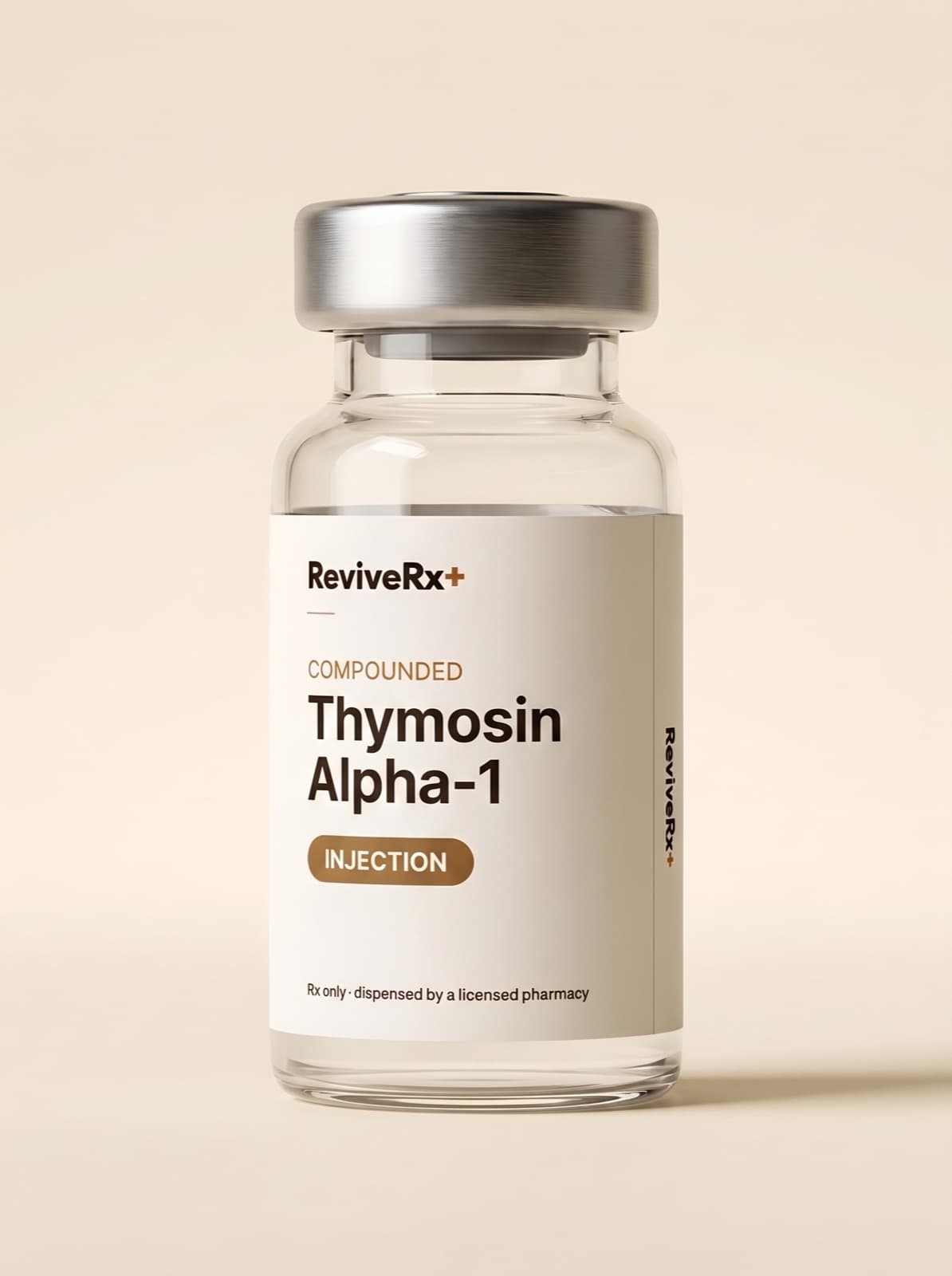
Not priced on the site yet
Compounded Thymosin Alpha-1 is on the formulary, but its price isn’t published here yet — so it can’t be added to a cart. The medications with a published price are listed by category.
See peptides optionsQuestions
Will I definitely be prescribed this?
No. A consultation does not guarantee a prescription. A licensed provider reviews your history at the visit and decides whether this is appropriate for you; because the substance is not on FDA's list for compounding and the human data is thin, many providers will reasonably decline. If they decline, the medication portion of what you paid is refunded automatically; the consultation fee is not.
Is this FDA-approved?
No. Compounded drugs are not FDA-approved, and thymosin alpha-1 has never been approved in the United States for any use, though it is registered abroad as Zadaxin. In December 2024 FDA's advisory committee voted 4 to 17 against adding it to the list of substances pharmacies may compound, so it currently has no lawful basis on that list.
Could this be withdrawn?
Yes. Its regulatory status can change at any time: FDA's advisory committee vote is a recommendation, FDA's own rulemaking decides the list, a state pharmacy board can act on its own, and our partner pharmacy can stop preparing it. If any of that happens we stop offering it, tell you, and refund the medication portion of any order the pharmacy can no longer fill.
Isn't it approved in other countries?
Yes — as Zadaxin, for chronic hepatitis B and, in some countries, as an adjunct to vaccines and to cancer treatment. That product is manufactured to a pharmaceutical standard and prescribed for those diseases by specialists. A compounded version prescribed for wellness is a different thing, and FDA's committee said as much when it found the evidence for the nominated uses unconvincing.
Will it strengthen my immune system?
That is the pathway it acts on, and we will not turn the pathway into a promise. The trials measured outcomes in people with hepatitis, sepsis, cancer or severe COVID-19; nobody has shown that a healthy person taking it gets fewer infections or anything else they would notice. Your provider will tell you the same.
How it works
Thymosin alpha-1 is a 28-amino-acid peptide produced by the thymus, the gland where T cells are trained. It acts on toll-like receptors on dendritic cells — the cells that present threats to the immune system — and pushes T-cell precursors toward maturity, which is why it has been studied as an immune modulator in chronic hepatitis B and C, in cancer alongside chemotherapy, in sepsis and, during the pandemic, in severe COVID-19; a 2024 narrative review counted more than thirty trials and over eleven thousand participants across those uses. Under the name Zadaxin (thymalfasin) it is a registered prescription medicine in a number of countries, but never in the United States. The distinction matters for what you are looking at: the trials were in patients with defined diseases, at pharmaceutical-grade doses, and a compounded version prescribed for general immune support has not been studied for that purpose at all. FDA's committee, reviewing the specific uses nominated, found the evidence unconvincing and voted 4 to 17 against allowing pharmacies to compound it.
The full mechanismA provider may consider it if
- Immune resilience is what you are discussing with a provider who understands that the trials were in defined diseases, not in healthy people
- You are comfortable with subcutaneous self-injection after instruction
- You understand that FDA's committee voted against it and that a provider may reasonably decline
It won’t be prescribed if
- Active cancer, unless your oncologist is directing it — abroad it is used alongside cancer treatment, and that is a specialist's decision, not a wellness one
- Pregnancy, breastfeeding or trying to conceive
- Autoimmune disease, an organ transplant, or anyone on immunosuppressant medication — stimulating T-cell maturation is the opposite of what that treatment does
- Chronic hepatitis B or C, or HIV — these need a specialist and, where appropriate, the registered product, not a compounded peptide for wellness
- Under 18
These are the same checks your provider runs in the visit. If one applies, they will tell you plainly — and the medication portion of what you paid comes back automatically.
What to expect
Weeks 1–2
Injection-site redness, pain or irritation is the common early experience. Low-grade fever or fatigue after a dose is reported.
Weeks 2–8
Human outcome data is limited — for a compounded product used for general immune support there is none, because the trials were in patients with specific diseases — so your provider will ask what you notice rather than promise anything.
Ongoing
Reviewed at check-ins. FDA's committee voted against it, so the likelier direction for its status is off the market rather than on; if that happens we stop offering it and tell you.
Safety
Side effects, before you decide
Injection-site redness, pain and irritation are the common ones in the trials of the registered product; low-grade fever, fatigue, muscle aches and nausea are reported. Because it stimulates immune activity, a flare of an autoimmune condition is a theoretical concern that the trials did not study. Human outcome data is limited — for a compounded product used for general immune support there is none, because the trials were in patients with specific diseases — and long-term safety data outside those settings does not exist.
- Dominari A, Hathaway D III, Pandav K, et al. World J Virol 2020;9(5):67–78 — thymosin alpha 1: a comprehensive review of the literature; a thymic peptide that modifies, enhances and restores immune function
- Dinetz E, Lee E. Altern Ther Health Med 2024;30(1):6–12 — narrative review of thymosin alpha 1 safety and efficacy across more than 30 trials and over 11,000 participants
- FDA Pharmacy Compounding Advisory Committee, briefing document and final summary minutes, 2024-12-04 — thymosin alpha-1
- RxList: Zadaxin (thymalfasin) monograph — SciClone Pharmaceuticals; registered outside the United States; read 2026-09-13
Complete safety information is provided during your visit and with every prescription. This page is a summary, not a substitute for your provider's advice.
Also for peptides
 Compounded CJC-1295 / Ipamorelin
From$199/mo$32 consultation included, not refunded · medication and shipping if prescribed
 Compounded Tesamorelin / Ipamorelin
 Compounded MOTS-c
From$239/mo$32 consultation included, not refunded · medication and shipping if prescribed
 Compounded MOTS-c / Tesamorelin
 Compounded Epithalon
From$349/12 wk$32 consultation included, not refunded · medication and shipping if prescribed
 Compounded Epithalon / GHK-Cu
From$219/mo$32 consultation included, not refunded · medication and shipping if prescribed
 Compounded Semax / Selank
 Compounded DSIP (Delta Sleep-Inducing Peptide)
 Compounded Pinealon / PE-22-28 / Selank
See whether compounded thymosin alpha-1 is right for you.
A licensed provider reviews your visit and decides. You receive medication only if prescribed, and that portion of your payment is refunded automatically if they say no.